

From Cichlidae to Aulonocara
Ethelwynnae belongs to Cichlidae, the cichlid family. Within that family, Cichlid Room Companion places it in the African subfamily Pseudocrenilabrinae, the tribe Haplochromini and the peacock genus Aulonocara. These are nested classification ranks, each narrowing the group we are discussing. Regan established the genus Aulonocara in 1922.
Its accepted scientific name is Aulonocara ethelwynnae Meyer, Riehl & Zetzsche, 1987. Unlike fishes that moved into a different genus after their description, Ethelwynnae was originally described in Aulonocara. It is a formally named species, so the informal qualifier “sp.” is not part of its accepted name.
Meet the Ethelwynnae Peacock
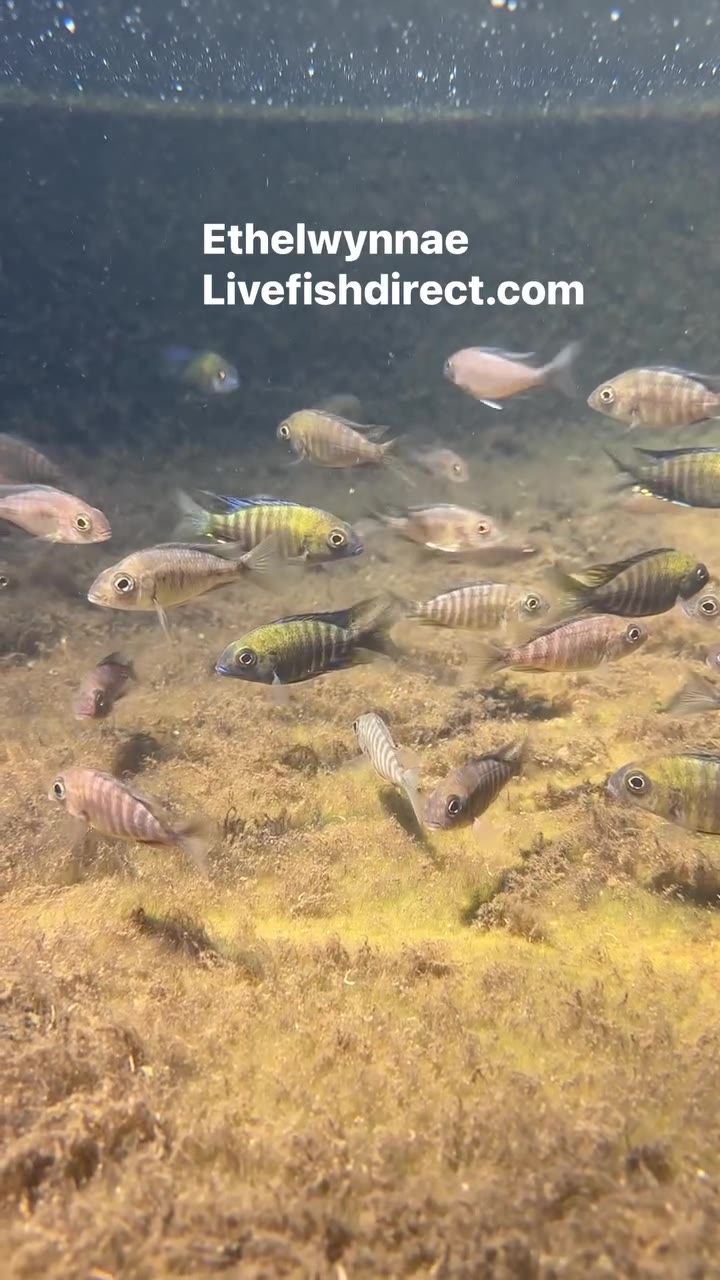
Our September 2026 FishVision™ clip begins above the circular farm tanks before taking the camera underwater with Ethelwynnae. It keeps the natural tank and farm sound. As the fish turn, look for the greenish body, long blue to blue-violet fins and prominent egg spots that caught Josh’s attention.
Josh considers Ethelwynnae his favorite peacock because it has its own look and personality. To him, that greenish body is an unusual and especially appealing feature among the Aulonocara he keeps. The footage shows our fish at filming time; use the current buying options for the size and sex you are choosing.
The woman behind the name
The species name honors Ethelwynn Trewavas, the British Museum ichthyologist whose life spanned 1900–1993. Her connection with Lake Malawi went beyond studying preserved specimens. The Natural History Museum records that she undertook a four-month survey of the lake's fishes and fisheries in 1939, when it was generally called Lake Nyasa; the results were published in 1942.
Trewavas began working with Tate Regan on African cichlids in 1928 and continued scientific work after her retirement. Meyer, Riehl and Zetzsche named this peacock in her honor in their 1987 revision of Aulonocara. She is the namesake here, rather than the author of the species description.
You may recognize her name from our Intermedius article: Trewavas described that fish in 1935. Following these names connects an aquarium fish with the people and collections behind its identification.
Lake Malawi and the Chitande connection
Lake Malawi lies within Africa's Rift Valley and is celebrated for its extraordinary fish diversity. The lake's habitats include rocky shores and sandy bottoms, with transition areas between them. A lake with so many different places to feed, shelter and breed supports far more variety than the phrase “African cichlid tank” can convey.
The type locality is Chitande Island, also recorded as Chitendi. Specialist accounts describe a sand-and-rock transition habitat; Cichlid Room Companion also reports this species at Mdoka and documents a male photographed at Chitande Island by Ad Konings.
Ethelwynnae is placed among the Chitande Types, an informal grouping that includes other related peacocks. A fish carrying a Chitande-type label is therefore not automatically this species. Keep the full name with your records when comparing fish or planning a breeding group.
What a peacock senses above the sand
Aulonocara combines words meaning tube and head, referring to enlarged sensory canals. The anatomy behind that name offers an explanation for the deliberate searching behavior associated with peacocks near the substrate.
In a 2012 study, Margot Schwalbe, Daniel Bassett and Jacqueline Webb tested a related peacock, Aulonocara stuartgranti. The fish located invertebrate prey in darkness, and temporarily inactivating the lateral-line system prevented feeding strikes in the dark trials. The experiment showed how sensing water movement can contribute to finding food when vision is unavailable.
That experiment was not performed on Ethelwynnae. It provides evidence about a related species and a useful window into the sensory equipment of the genus. The familiar description “sonar feeder” should not be taken to mean that these fish send out sonar signals.
Three questions for Josh at the farm
What makes Ethelwynnae stand out? For Josh, it is the combination of a greenish body and long, pretty blue fins. He sees a different character in this fish from many other Aulonocara, and that individuality makes it his favorite peacock.
What does Josh value about its appearance? He loves the natural beauty of the species: a fish that is already beautiful in its Lake Malawi home. Its own colors, proportions and fins are the attraction for him.
What is its personality like? Josh finds Ethelwynnae especially clever and notices individual personality in the fish he keeps. To him, they seem unusually mentally engaging. That personal impression is part of the pleasure of keeping them and spending time watching what each fish does.
Plan the aquarium around the floor
A four-foot tank is a sensible starting point. Provide open sand for searching and secure rockwork for retreats. Keep enough floor space free for fish to forage and move between shelters.
Plan around the eventual adults and the space occupied by their companions. Check that subordinate fish can withdraw.
Water and everyday feeding
Use a mature, biologically filtered aquarium with stable alkaline water. For routine aquarium care, aim for 24–26°C (75–79°F), pH 7.8–8.5 and approximately 12–16 dGH, with regular testing and water changes.
Offer an appropriately sized complete cichlid food, with small invertebrate foods such as brine shrimp as supplements. Check that each fish gets access to food; a busy feeding surface can conceal an individual that is repeatedly pushed away.
Planning for a grown peacock
Seriously Fish lists Ethelwynnae at 11 cm standard length, about 4.3 inches before the tail fin. That gives an adult scale to consider when planning the aquarium.
Standard length stops at the tail base; total length includes the tail fin. Allow room for your fish and its companions to grow, and use the current sale label for the size of the individual fish being offered.
Companions and breeding groups
Choose calmer Malawi companions and watch territorial males. Most boisterous mbuna communities are a poor starting point for this comparatively quiet peacock. Persistent chasing, hiding or missed meals calls for a change in the arrangement.
Keep breeding groups separate from other peacocks. One male with several females is a starting arrangement, with retreats provided. As a maternal mouthbrooder, the female carries eggs and young in her mouth.
The anal fin's striking egg spots do not guarantee sex; females can have them too. Record the stated sex and full species name. Claim a locality only when the line has supporting records.
Choosing your Ethelwynnae at Live Fish Direct
Decide whether your priority is raising young fish, adding a specifically labeled male or establishing a breeding group. Then match that goal to the available options. An unsexed fish is not a confirmed male, and a video of a colorful adult should not override the description of the option in your cart.
Keep the species name, purchase date and size-and-sex label in your own aquarium notes. Those simple details make later comparisons more useful, especially if you eventually keep several similar peacocks. They also give us a clearer starting point when you ask about the fish you bought.
Sources and further reading
- Eschmeyer's Catalog of Fishes — accepted name and original description
- Cichlid Room Companion — classification and Chitande localities
- ETYFish — Aulonocara and ethelwynnae name origins
- Natural History Museum — Ethelwynn Trewavas archival biography
- UNESCO — Lake Malawi National Park and lake setting
- Schwalbe, Bassett and Webb, 2012 — sensory prey detection in Aulonocara stuartgranti
- Seriously Fish — Ethelwynnae aquarium husbandry
- AquaInfo, John de Lange — aquarium setup and reproduction
- FishBase — recorded standard length and biology
- Florida State Museum Bulletin — standard and total length definitions
- LFD Ethelwynnae farm clip — filmed fish and original caption