

Start with the traditional Flameback
Before the albino form, there is the traditional Kyoga Flameback: a Ugandan cichlid whose mature males combine warm red and yellow with green tones and darker markings. The bright upper color makes “Flameback” an evocative aquarium name. Females have a quieter silver or gold appearance, so the familiar male portrait represents one part of the fish's life.
Cichlid Room Companion records the fish as Haplochromis sp. 'kyoga flameback' and illustrates a male from Lake Nawampasa, Uganda. That is a useful starting point: a recognizable fish, a named locality and a scientific identity that remains provisional.
Our albino line adds its own chapter. To understand what we have been selecting at the farm, it helps to follow that older fish back through its names and the landscape behind them.
Following the family tree
The Kyoga Flameback belongs to Cichlidae, the cichlid family. Cichlid Room Companion places it within the African cichlid subfamily Pseudocrenilabrinae and the tribe Haplochromini, with Haplochromis as its genus. These are progressively smaller branches of its classification; “haplochromine” describes the wider group, while Haplochromis is the genus used in this particular account.
Haplochromis has a much older history than the Kyoga Flameback's aquarium label. Hilgendorf introduced the name in 1888, with the fish then called Chromis (Haplochromis) obliquidens as its type species. As Christopher Scharpf explains in The ETYFish Project, the “haplo-” element refers to simple, unnotched teeth in that original context. It was a name concerned with anatomy, long before aquarists were selecting this albino form.
You will also find Kyoga Flamebacks labeled Xystichromis. CRC includes Xystichromis Greenwood, 1980 in its synonymy of Haplochromis. For this page we follow CRC's Haplochromis usage and retain “sp.” and the quoted working name. The genus is established; the Kyoga Flameback form remains undescribed in the specialist account.
A landscape of shallow water and papyrus
Lake Kyoga lies in Uganda, north of Lake Victoria. The Victoria Nile carries water from Victoria through the Kyoga system, before continuing toward Lake Albert. Think of a broad, shallow lake connected to smaller lakes and extensive wetlands. Papyrus fringes the shores, and water lilies cover sheltered shallows.
This setting helps explain why the convenient aquarium label “Victorian cichlid” deserves a closer look. It can point toward fishes from the wider regional drainage, including Kyoga's own lakes, rather than guaranteeing an origin in Lake Victoria itself. Kyoga is also a different lake system from Lake Malawi, home of the familiar mbuna and peacocks.
Lake Nawampasa is one of the small lakes in this story. Uganda's fisheries researchers surveyed the Kyoga satellites in the 1990s and recorded a rich variety of fishes and feeding groups. Their work showed why a small patch of water could deserve attention alongside its much larger neighbors.
The Flameback name has a history
A revealing detail appears in a letter by biologist Les Kaufman, published in Aquatic Survival in December 1995 after fieldwork in Uganda. He warned that the Nawampasa fish being traded as “flameback” differed from the Astatotilapia he had originally given that name. The traded fish, he explained, was a small, undescribed Haplochromis that grazed periphyton.
Periphyton is the living coating on submerged surfaces, including algae and associated microorganisms. The observation gives the historic Nawampasa fish an ecological identity beyond its color: it was harvesting food from a surface. Kaufman's account also makes the naming problem tangible. Attractive aquarium names could spread while different fishes were still being sorted out.
That history is why we keep the full Kyoga Flameback name. A shared “Flameback” label alone cannot establish that two aquarium stocks are the same fish.
Many years of selection at Live Fish Direct
Albino describes the change in dark pigmentation; it does not mean a fish must appear uniformly white. In our line, the red is the attraction. Josh puts it this way: “There isn't a more stunning red possible on a cichlid.” That is our enthusiasm from living with these fish, and the reason we keep returning to them.
It has taken many years of selection at our farm to develop the consistency we value in this strain. Our albino Kyoga Flamebacks are an aquarium line, with their own breeding history at Live Fish Direct.
Consistency still allows individuality. The fish shown in a photograph or video is a reference for the line's appearance, while the size and sex listed with each available option describe what you are ordering.
Inside the tank: September 2026
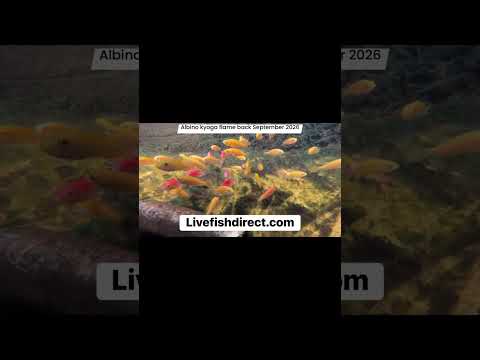
Our September 2026 LFD FishVision™ footage takes the camera straight into the Albino Kyoga Flameback tank. Pale yellow and orange fish, with pink and red accents, move around surfaces covered in algae. The clip keeps the natural sound of the tank and farm.
A short underwater visit only catches part of their character. In our everyday experience, these fish are active and curious, with more personality than this brief scene can show. The color draws you in, but their interest in what is happening around them is a large part of their appeal.
Temperament and tankmates
At our farm, we find Albino Kyoga Flamebacks relatively mild in temperament, while still able to hold their own with suitable more assertive fish. We have found them a useful option alongside appropriately chosen mbuna, peacocks and haps.
Treat that experience as a starting point for a particular aquarium. Match fish by adult size and temperament, provide room and places to break contact, and watch the individuals after introduction. A workable mix lets every fish feed and move through the tank without being persistently cornered. A category name such as “mbuna” covers many temperaments, so it cannot guarantee compatibility.
For a breeding project, keep the line separately from similar Victorian-region cichlids. A mixed display and a group intended to produce known-parentage young call for different stocking decisions.
Size, aquarium setup and feeding
Plan for roughly 5–5.5 inches as an adult reference. The Nordic Cichlid Society's traditional-form profile lists 14 cm, along with a 200-liter aquarium baseline and 100 cm length. A standard 55-gallon, four-foot aquarium is a useful starting point for planning, with more space appropriate for additional adults and mixed groups.
The same profile gives 72–82°F (22–28°C) and pH 7.5–8.0. These are published parent-form guidelines, rather than measured limits for our albino strain. Use an established aquarium with stable water conditions, swimming room and sheltered areas.
A varied prepared cichlid diet with plant and animal ingredients is a practical approach. In her first-hand Kyoga account, keeper Brenda of Everything Aquatic describes feeding spirulina flakes, African cichlid pellets and frozen foods. The historic grazing observation gives useful background, without requiring a home aquarium to reproduce every part of the wild diet.
Mouthbrooding and choosing your fish
Kyoga Flamebacks are maternal mouthbrooders: after spawning, the female carries the developing brood in her mouth. That quieter part of their biology is easy to overlook when the brightest fish gets the camera's attention.
Choose from the sizes and sexes currently available above. An unsexed juvenile does not come with a guarantee that it will become a display male. If a male is essential to your stocking plan, select an option explicitly labeled male.
For us, the combination is what makes this line special: the red we have spent years selecting, an engaging personality and a place in a much older Ugandan cichlid story. Watch the tank for a moment, and there is more to appreciate than color alone.
Sources and further reading
- Cichlid Room Companion — traditional Kyoga Flameback profile and Lake Nawampasa photograph
- Cichlid Room Companion — Haplochromis genus, 1888 description and Xystichromis synonymy
- The ETYFish Project — Haplochromis name and original anatomical meaning
- NaFIRRI — Kyoga basin geography, Technical Reports 2006
- World Lake Database — Lake Kyoga, shallow-water and papyrus setting
- Uganda fisheries research — Kyoga satellite lake survey, 1999
- Les Kaufman — Lake Nawampasa field letter, Aquatic Survival, December 1995
- Nordic Cichlid Society — traditional Kyoga Flameback size and aquarium guidance
- Everything Aquatic keeper account — Kyoga Flameback appearance, feeding and breeding
- LFD FishVision™ — Albino Kyoga Flameback tank, September 2026